Tuesday, July 28, 2020

LAFC: probably still underrated


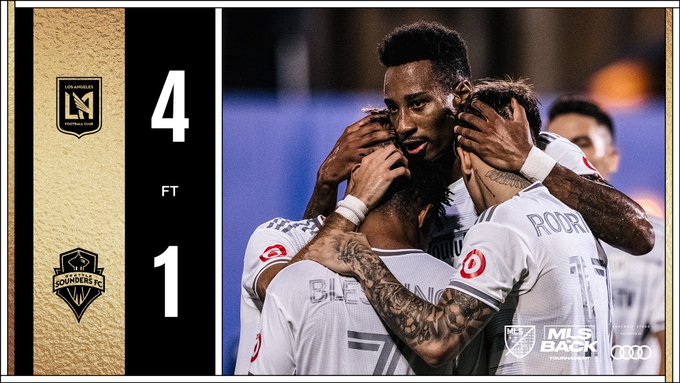
LAFC, when they're mentally locked-in; which they were last night, probably play the best soccer MLS has ever seen.

They press when they need to; they posses when the need to; they build out of the back; they think they're way through an opponent; and they maximize the strengths and minimize the weaknesses of damn near every player on their roster.

What they did to Seattle in the Round of 16 of #MLSisBack was as strong of a flex as I've seen watching Major League Soccer since '96. Particularly the first 15 minutes or so. It was LA's peak iteration of "heavy metal football."

However, given their notable playoff failure (tournament luck is fickle), I think popular consensus--such as it exists--still underrates just how good Bradley's squad is.

Their record breaking campaign last year plus their early performances sans Vela in Orlando rival or exceed: Josef-Miggy ATLUTD,  Giovinco TFC, Donovan-Keane LA Galaxy, and Prime Era DC United. 

Perhaps the highest compliment I can pay them is that every time they play it's worth watching. MLS has had too few clubs to say that about in its history, don't miss it this time. 


Thursday, July 16, 2020

What the Hell Happened to Atlanta United?!

Atlanta United FC to unveil inaugural home kits on Tuesday, Nov ...

With their early morning loss to FC Cincinnati in the Disney bubble we've reached the lowest point in Atlanta Untied's MLS history. This club was built with very big ambitions by an all-in owner and a front office with plenty of savvy to pull it off; and pull it off they did. 

Eales, Boca, and McDonough  landed Tata Martino, and then found Miguel Almiron and paired  him with Josef Martinez. That was the magic. But they also drafted Julian Gressel, and added Darlington Nagbe and sold Miggy to Newcastle for a record fee.  For four(ish) years, dating back to the club's launch, it seemed like they were a step ahead of anyone in MLS; and that they were on the level with the biggest clubs in the hemisphere. 

That feels like a lifetime ago now. That club, let's call it Atlanta 1.0 through 1.5, has been systematically disassembled. 

Atlanta 2.0 is something very, very different.

  • McDonough gone to Miami 
  • Tata gone to Mexico
  • Miggy gone to Newcastle
  • Villabla gone to Libertad
  • Gressel gone to DC
  • LGP gone to Miami 
  • Nagbe gone to Columbus
  • Garza gone to Cincinnati
  • Pankhurst gone to retirement
  • Lawrentowicz gone to the bench    
As fast as they built it, it was over. It's we're now living through Newton's third law applied to club construction. "Every action has an equal and opposite reaction."


Whereas Tata was a Bielsa-like philosophical center of gravity for the entire organization, Frank de Boer is a manager with ideas that don't mesh with the roster; don't fit with the aesthetic and identity #ATLUTD fans came to cherish, and don't give his squad any sort of competitive advantage against the rest of the league.

Whereas Josef, Miggy were supreme DP signings each subsequent bite at the apple has gotten increasingly less satisfactory; highlighted by the total miss on Pity Martinez.


And perhaps the biggest turn of fate is that the original vintage of ATL was must watch soccer because they had so much buzz and enthusiasm -- a very enviable eff you quality to them. This vintage tho? It couldn't be more stale, boring, and not worth watching but for the morbid curiosity.

They built it once, so perhaps they can do it again? But it's hard to see Eales and Boca overseeing a thriving Atlanta 3.0 given how the last 18 months have gone.

Wednesday, July 15, 2020

MLS is Back

MLS is Back Tournament - Wikipedia

Humor me for a minute and set aside the trouble Major League Soccer had establishing their bubble down in Orlando; I realize that's a big ask. The concept--which I was critical of--is turning out to be a rather good formula for the league. Daily action, the early morning and late at night time slots, wild finishes, and the usual MLS tomfoolery have lead to something of a qualified success.
No small amount of this is due to the lack of other American sports options (though global soccer options have never been so numerous) but I think even in non-pandemic times, MLS would be wise to replicate #MLSisBack on an annual basis.  My guy Sanjiv (aka @USMNTvideos) floated the idea of simply replacing the first six regular season games with the tournament. I think that could work.

I also think it'd be worth considering playing the tournament during the dog days of summer; when in normal times trips to Dallas, Houston, Orlando, Miami, and soon to add Nashville, Charlotte and Sacramento will mean playing in heat and/or humidity that largely keeps fans at home during the daytime hours.

Obviously this would mean playing in Northern locale; perhaps the PNW or Toronto or Montreal as opposed to a warm weather resort (I suppose if they really wanted to get audacious they could hold this sucker down in Mexico); and we probably don't need the CCL tie-in going forward, but I could be convinced it makes the games more important and is therefore worth keeping, either way a tournament is a good idea.

Even if by accident it seems like Don Garber & Co. have stumbled into something worth doing here.
In future years we'd have league's biggest stars at the tournament, and even more importantly we'd have fans at the games. One of MLS' strongest attributes is it's fan culture and the dedication of its travelling supporters groups. I can hardly think of a better idea than a MLS fan festival with meaningful games to boot.

Don't get me wrong, there's still plenty to criticize and I've made my objections clear on my twitter timeline, but we are entering the stage where the games are getting fun and we're seeing the potential of a non-pandemic tournament in MLS.

Here's hoping this isn't a one-off! 

Friday, November 8, 2019

Berhalter should Stay?

There's so much garbage on the internet. Even more so on twitter dot com. But maybe the most is within a subset of twitter dot com obsessed with the United States Men's National Team. It's particularly vitriolic and full of the internet argument greatest hits:  ad hominem, whataboutism, confirmation bias.

Why am I saying this? 

Because even within that context it's possible and, frankly, necessary to thoughtfully criticize much (most?) of what's going on within U.S. Soccer and specifically with the MNT. And while I'm just a guy #onhere, I'd like to think I can move those of us who are both fans and advocates for American soccer into a better version of this conversation. 

So, here we go.

Gregg Berhalter was one of the two best realistic options to take over the MNT after Dave Sarachan's caretaker tenure. We can debate Jesse Marsch vs Berhalter, especially given Marsch's early success in Europe but let's not act like because Gregg's brother Jay is a top U.S. Soccer executive, he wasn't qualified then or now. So set the process concerns aside for the moment (Those are for another post).

What clearly isn't working is Gregg's ability to transfer what made him a successful club coach--remember we're talking about the first American to manage a professional team in Europe--to the international level.

What's confusing to me is why can't he do it (yet)?

By the end of his time at Columbus Crew, Berhalter's teams played with--perhaps--the clearest sense of identity in MLS. Highly respected coaches, like Tata Martino, Patrick Vieira, and the aforementioned Jesse Marsch are all on-record complimenting both the style of play, and the execution of those Columbus teams as some of the best they'd encountered. Point being: it's not as if Gregg doesn't know what he's doing. 

So what are some possible explanations? I think there are versions of three possible answers:

  1. His preferred methods of playing and coaching need to change. 
  2. The players aren't good enough. 
  3. It will just take time.
Let's take those one at a time.

1. His preferred methods of playing and coaching need to change. Most international managers make the game as simple as possible (with a few notable exceptions). Berhalter isn't doing that. Given the extremely limited instructional time he has with his players, the often competing roles or expectations they have with their clubs, and the nature of tournament play he's simply asking too much of the "group." He's certainly tried to address this with extended camps, skype video sessions, etc. but players still exhibit role confusion on the field; lack game awareness; and, generally worse playing for the MNT than with their clubs. All of these things are evidence that the approach isn't effective.   
2. The players aren't good enough. Much as we like to blame Berhalter, there is something to this. Brian Sciaretta's excellent article, "The Missing Years: US Soccer's Development Gap" is essential reading on this point. The age cohort (25-30) who should be leading the MNT are MIA. This has placed Berhalter in a no-win situation. Young players and prospects don't win at the Senior International level. They just don't. And yet the u23's are, by far, our best players. He's clearly trying to integrate the young players with veterans in a way that doesn't ruin their long term advancement. One can argue with his methodology, clearly it's not getting great results, but to argue that rolling out a u23 roster for the next 18 months is his best option is a non-starter.    
3. It will just take time. Think of the Dutch or the Spanish national teams. They play with a signature system based on their aesthetic understanding of how the game should be played. (Brazil is in a bit of a different category for me, but I'd be fine if you included them in this group.) This is more-or-less what Berhalter has set out to accomplish. (i) It's is a very exclusive group who've achieved Sr. Team success playing in a very idealistic way. Notice, France, Portugal, Germany, England, et al aren't in this group. (ii) Success for these 'aesthetically idealistic" teams has been inextricably linked to generational talents more so than to the "system." (iii) It's taken decades of coherent, national, effort to create these identities and the structures to identify and train players to live into their country's soccer worldview. (iv) In each of these examples, overall national identity is deeply connected to the sport of soccer. None of this is impossible in the U.S. but even the most ardent supporters have to confess we're nowhere close on any of these things, and it's going to take a lot longer than the Berhalter era to get there.  

Something can be more than one thing, and I think all three of these explain Berhalter's struggles. That's not super satisfying, and I think it builds more of a case than I originally expected for keeping Berhalter regardless of the medium-term struggles: he needs to grow/adapt into the job, our best players simply need time to mature, and US Soccer needs to get its sh*t together. None of that will be accelerated by firing Gregg. 

I'll admit, I'd like there to be a fast-track through this era of U.S. Soccer that doesn't include the frustration of an incompetent federation and coach who needs to grow on the job, but I don't see a realistic path forward that avoids these realities.  


Monday, July 2, 2018

The Complicated Joy of Soccer


This is ostensibly a platform for me to write about American soccer -- MLS and USL, and that's what I've used it for. To frame this differently, I've intentionally boundaried this space from the other topics I often write about: politics and religion

It seems, though, like the time has come to take down those walls, if only for a little while, to acknowledge that while the soccer is center stage during the World Cup, the world's game is equal parts relief from an unending barrage of socio-political upheaval as it is deeply enmeshed in that very same turbulence. 

That's not breaking news to anyone reading this, but it does warrant saying out loud. 

I, like many others following this tournament, have chosen to use my social media platforms to comment almost exclusively on the games (matches) themselves. 

For me, this has been a very intentional choice –– opening the door, even just slightly ajar, to the abyss that is everything besides the games felt as though I'd never be able to watch with any joy at all. 

That was the wrong choice. 

The tournament itself has been perhaps the best World Cup in modern memory –– a hypothesis underscored by today's stunning Belgian counter attack for the ages. But while Lukaku was somehow in a state of mind to let a lifetime of glory roll between his legs (certainly the most glorious "dummy" I've ever seen), my mind was drifting to a world fraught with war, hunger, isolation and desolation. 

As Chadli formalized the most famous six touches in Belgian footballing history I  could only think: damn you, Vladimir. 

Not only is your side through to the quarterfinals amid doping rumors, you're playing host to an unimaginably good sporting event. One that will be remembered forever alongside your thuggery, murder, and hijacking of history. 

While this isn't the first World Cup to be played under the smoke of a burning world, it is the first one since 1934 that's been so intertwined with it –– FIFA's now exposed corruption fully welcomed in Putin's Moscow. 

It's all so inescapable. 

I've been challenged by the reporting of Clint Smith, Laurent Dubois, and Karim Zidan as well as few others during the course of this tournament to see the whole, complex, story unfolding before us. That while we enjoy the sport we can––and must––engage with the world that remains lest our temporary joy be the tyrant's permission.

Saturday, June 16, 2018

Landon Donavan, El Tri, and US Soccer's never ending issues

In the absence of actual World Cup games featuring the United States Men's National Team,  #USMNT twitter went off the rails today when Well's Fargo launched a social media ad campaign featuring Landon Donovan utilizing #MyOtherTeamisMexico.

Donavan, predictably, was on the receiving end of immediate backlash from fans and former national team players alike -- most notably Carlos Bocanegera and Herculez Gomez.
Behind the social media fiasco--which takes on additional meaning given our socio-political moment--is something worth talking about, though.

There's a real tension and, frankly, ignorance around the multicultural identity of the men's national team. Wells Fargo's ad is based in the assumption that there's significant overlap between soccer fans living in the United States, but of Mexican citizenship or descent.

As a brand, Wells Fargo clearly preferred to build an ad campaign around an American team in the World Cup but weren't willing to be sidelined during the month long tournament once the USMNT failed to qualify.

The strategy was basically to put the core elements of their ideal campaign into a blender. What came out was the most iconic player in American history pimping a corporate sponsorship by endorsing America's biggest soccer rival. (Of course it's even more layered than that given Donavan's exit from the national team.)

As dumb as all this sounds, it's basically the same approach major stake holders--including U.S. Soccer--have taken over the last two-plus decades in an attempt to "grow the game" in America, and the results have been similar.

Paying lip-service to the "emerging Latino market" has landed America's soccer gatekeepers in trouble before.

Perhaps the most obvious example is the Chivas U.S.A debacle, but there are others more specific to the national team. Just look to the youth development foibles of the late. (I wrote about the Jonathan Gonzales situation on this blog.) Or at the tension around Klinsmann preferencing German-American players.

These are the direct result of cultural incompetency -- a misunderstanding of how complex the mixture of sport, culture and identity are.

My point tonight isn't to write in-depth about each and every instance of cultural incompetency, nor is it even to delve into solutions. It's simply to say: these aren't just gaffes to paper over.  This is difficult stuff that should occupy both America's soccer intelligentsia and it's executives. 

Sunday, April 22, 2018

How Good are the Foxes? Pt. 2

Continuing in this series, "How good are the Foxes?

The question for me, this time, is how good is Noah Verhoeven

Verhoeven is the one legitimate MLS prospect on the Fresno FC roster in 2018. At 18, Verhoeven is a product of the Vancouver Whitecaps residency training program. He's also been called in to U.S. under-18 and under-20 training camps. 

While Verhoeven profiles ahead of the rest of the roster as a pure prospect he's not the only MLS calibre player in the Foxes XI. 

Pedro Ribeiro, who's recent golazo got international attention, has logged substantial time for Orlando City SC. It was Verhoeven who delivered the ball to Ribeiro to setup the screamer from distance in the 27th minute. 


Cutting in, hard, from left side Verhoeven shows in the highlight the most appealing aspect of his game -- sudden, attacking, movement with the ball on his foot. The lay-off to Ribeiro was the obvious choice; and frankly isn't an overly impressive play in-and-of-itself (it was 99% Ribeiro's individual brilliance). However, the cutback; on to his right-foot, is really good.

For the Foxes to improve, and for Verhoeven to take the next step in his development, he needs to build on his tendency to dribble the ball for the purpose of creating passing lanes and instead push the ball to create his own scoring opportunities. 

Take a look at his chart vs. Tulsa: one shot in Zone 17. 


Now, he's playing wide in a 4-4-2, so his primary responsibility is to find Caffa (and whoever is playing beside him) in the channel he [Verhoeven] has created because of his pace and space. BUT, to truly unlock a dynamic attack Verhoeven simply has to put his head down and go at goal at least a couple of times every '45.

When he gets comfortable enough in the system to play with some ambition, watch out! He certainly has the skillset to do it.  


Monday, April 16, 2018

How Good are the Foxes? Pt.1

To answer that we have to answer, "How good is Juan Pablo Caffa?"

Fresno FC are lead by the veteran Argentinean. With two seasons in La Liga, at Real Betis ('06-'08), Caffa is--by far--the most accomplished player on the roster, and one of the most experienced players in the league.

That said, Caffa's days as a rotation player at the highest level of Europe are more than a decade behind him. While he's still the technical class of any Foxes XI, his ability to play at pace is substantially diminished. Don't believe me? Check out his separation and finishing once upon a time.


(I believe this is from the '02-'03 season with Boca Juniors)

At 33, his play is forced to be far more cerebral; and by all accounts focused on connecting with younger player.

So, how's he doing in that role for Fresno FC? 

Through five matches I'd say it's been a mixed bag. During the home--and season--opener versus Las Vegas FC Caffa was conspicuously absent from the Foxes attacking play. 

His first-half heat map was more or less what Coach Adam Smith was looking for –– heavy to the left-side and relatively prevalent in Zone 14.

However, when you overlay that with his passing/shot chart, the result isn't nearly as impactful. Takeaway the one set piece shot, which was threatening and on-frame, and Caffa only made one attacking pass from Zone 14 into Zone 17 in 49:00. 

What's more, after falling behind 0-3 in the second half, Caffa dropped deeper, and deeper, as the game progressed to pick up the ball. Here's his 2nd Half heat map:


Suffice to say this isn't what you're looking for from your best creator. Compare the LVFC chart to  Caffa's contribution in what was likely the club's best performance in a road win at Seattle Sounders 2:

Positionally, this is much more in-line with where I want to see Caffa on the ball –– though not exactly where I'd like to see him. 

(A brief aside: It should be said, the Foxes have played in several formations so far this season, and have even played a few different attacking concepts within the formations they're going to regularly; like the 4-4-2. So, doing a direct game-to-game comparison  of a single player isn't going to be super fruitful. However, from my persecutive, the relevant question to ask of any formation is, "is this putting the best attacking players on the ball in attacking positions?" With a player like Caffa in particular, the goal is to get him the ball in space with time to create.

Given the nature of a totally new club, with a coaching staff and players learning each others strengths and tendencies, it's not at all surprising to me that it's taking a bit of time to sort out how to get your best player(s) consistently good looks to create goal-scoring chances.

Caffa is certainly [still] technically and tactically good enough to impact every game in a positive way for the Foxes. Time will tell if he's given the freedom to do so. 


Wednesday, January 10, 2018

U.S. Soccer Youth Development -- Part 2

In Part 1, I highlighted two issues that are critical to solve for successful youth development: 

  1. Difficulty finding quality coaching; and the cost(s) associated with accessing quality coaching 
  2. As a result of the first point, youth development is still built largely around upper-middle class white families.

So in Part 2, it seems important to spend some extended time on why diversity matters both in terms of the on-field results and in terms of creating a healthy, well functioning, national soccer federation. 

In terms of fielding globally competitive teams at each age group; including the senior team, developing players of diverse backgrounds is a non-negotiable. 

As I've previously eluded to, culture influences style(s) of play in very direct ways and sets the foundational or platonic ideal of what it means to be a great player. 

Mexicans and Germans, for example, have different--if not competing--epistemological concepts of greatness on the pitch. 

If you're unread in this subject area, I suggest starting with Johnathan Wilson's classic, "Inverting the Pyramid" as well as Franklin Foer's, "How Soccer Explains the World".

Given, then, that players from diverse backgrounds carry with them different basic understandings, based on core cultural values, of how to solve on-field problems integrating America's diverse soccer playing population into a coherent soccer "worldview" becomes a mission-critical objective. 

And, to be fair, under the direction of Tab Ramos there has been noticeable improvement integrating Latino players and styles into the American playing paradigm. 

However, the fact remains Latino players in particular are not well integrated, understood or valued in on-field terms within U.S. Soccer (to say nothing of lifestyle or cultural obstacles) -- particularly at the senior team level. Don't take my word on it. Read this excellent interview in SoccerAmerica

Brad Rothenberg, who's as qualified as anyone to speak on this subject, details the dynamic in very plain terms. In the most telling except (for me), Rothenberg says,
I’ve grown tired of watching our federation neglect this community. We didn’t do enough, not nearly enough, to keep him. And the worst part is that it will continue if wholesale changes aren’t made in the approach to finding talent in this community.The paucity of coaches employed by U.S. Soccer with an interest in Latino style of play is a problem. Tab Ramos isn’t enough. Bring back Hugo Perez. Jonathan wasn’t the first and will not be the last player lost to the national team until major shifts take place at the federation.
Not only does this ring true based on my personal experience as a youth coach in an exclusively Latino context, it lays bare the basic reality that U.S. Soccer is not trying to put the best possible combination of players on the field.

To put it another way, by not actively cultivating, training and financially investing in Latino players and coaches U.S. Soccer is acting in direct opposition to it's core mission.

(This seems to be a good stopping point, so I'll write Part 3 about the organizational aspects of diversity another night.)

More to come...


Monday, January 8, 2018

Jonathan Gonzalez and USMNT Youth Development -- Part 1

Jonathan Gonzalez shook-up what was going to be an otherwise nondescript January camp by letting it be known he's going to play for El Tri at the senior national team level; meaning he will be "cap-tied" to Mexico going forward. 

As this relates to Gonzalez, it's a big deal because he's an elite-level young player. The U.S. Men's National Team certainly would benefit from his skillset as a shut down d-mid as the current positional core group phases out prior to the 2022 cycle.

If you want to read more about the Gonzalez situation specifically, I suggest Steve Davis' piece in FourFourTwo and Matt Doyle's "Arm Chair Analyst" column on the subject. 

What I'm most interested--and have tweeted about extensively--is the underlying issue(s) US Soccer has within its player development paradigm relative to Latino players. Specifically, Mexican-American players. 

Two basic but critical structural issues to highlight:

  • High-level coaching is extremely difficult to find and it's incredibly expensive to utilize. This is exact opposite of an effective strategy to develop the widest array of potential USMNT players as is possible; which one would assume should be the goal of US Soccer. 
  • Youth player development is (still) built around white upper-middle class families. The stereotypes of soccer mom's exist for a reason. With the switch to a quasi-academy model in 2007 players need access to one of 197 affiliate clubs. These clubs need to fund their coaches, trainers, equipment, etc. to do that, they need enough players who can pay their full fees to offset the scholarship players. It's pretty simple, really.

There's more to each point, clearly, but the net-effect is that because of these issues there are entire communities disconnected from US Soccer's youth development project. It gets even worse when you realize that the communities which are being left aside are the talent producing ones. To put it another way, the "system" isn't designed for Mexican-American youth to be identified and/or developed by-and-large.


As a result, when a dual-eligible player like Gonzalez is available and chooses to play for Mexico, it's a huge blow because there aren't hundreds prospects lineup to take his place; which is a shame because there should be.   

More to come...

Monday, October 23, 2017

Playoffs Preview

I've been away from this blog for the past five weeks or so adjusting to the rhythms a new job. In the past, I worked from home and set my own hours; and could write about soccer more. Now, I'm in the office with much more standard hours. Such is life.

Anyway, I've been watching games same as ever and what follows is a brief playoff preview -- this is less of a comprehensive run down of all the match-ups, and more of what I'm interested to see. 

Does momentum matter? This is the question going in to San Jose's game at Vancouver. The Whitecaps mid-season run of form compared to the Quakes mid-season missteps have setup a classic playoff phenomenon: an above average team coasting into elimination play versus a below average team who has played with desperation to make it into the tournament on the last day. On the surface, Vancouver is substantially better than San Jose; who have a -19 goal differential. That said, in their last three results San Jose have two wins and a draw whereas Vancouver have two losses and a draw. 

Can Atlanta find their form again? On Wednesday, September 13th ATL scored seven versus New England. It was emphatic. It also changed the narrative of their season. Instead of an over achieving expansion club content with huge crowds and positive results, expectations shifted towards MLS Cup. Since then,  injuries have cut into the hype. A win vs. Columbus, who haven't lost since August 5th at San Jose, won't come easy. To advance United are going to have to find that mid-September attacking genius. 

Is there one more great run left for SKC? This is surely the end of the line for one of the quintessential groups in league history. The Veremes, Besler, Zusi, Feilhaber, Espinoza core has been great. They've won all there is to win: U.S. Open Cup(s), Supporters Shield's, and MLS Cup; and in so doing created a unique and important soccer fanbase in the heart of the country. In many ways, this group represents MLS's growth into an established global league with real staying power. Can they find the magic one more time?   


Wednesday, August 30, 2017

Minnesota United - August 26th

There's been very little to write about Minnesota all season long. Unlike Atlanta, who've taken a savvy--and high dollar--approach to MLS expansion, the Loons haven taken what could most generously be called a "different" approach.

Minnesota made some good summer moves, and finally got a road win on Saturday (8/26) to show for it. It would be easy to interpret their 2-1 win over Chicago solely through the Fire's lens; which isn't pretty, but given this is likely to be the best result for Minnesota all season let's focus on it from their point of view.

First, Abu Danladi's pace was a real weapon (like usual) and he did well enough to finish two pretty easy chances (unlike usual) for a first half brace. Danladi has loads of potential as pure line-running goal scorer, but at this point in his development he lacks the first-touch to consistently put away the goal scoring opportunities his speed and positioning regularly creates. It should also be said: Danladi reads the game well; subjectively I'd rate his "soccer I.Q." as far above average, thanks in large part to coming through one of the best college soccer programs in the country –– UCLA. As his technical ability catches up to his natural ability, I suspect Danladi will become double-digit goal scorer.


Second,  the additions of Ethan Finlay, Sam Cronin, and Sam Nicholson have created a midfield that can at least compete against MLS-level opposition. That might sound like a low bar, but previously Minnesota were basically a non-MLS team in the midfield.  The Loons play five midfielders so I've isolated the completed passes for Finlay and Nicholson, while including Cronin and leaving out Ibson and Molino, comparing Saturday's win at Chicago vs. the 6/29 loss against NYCFC. Check it out:

Minnesota United Midfield passing versus Chicago Fire
Cronin, Finlay, Nicholson completed passes vs. CHI - 8/26

Minnesota United midfield passing versus New York City FC
Cronin, Ibarra, Venegas completed passes vs NYCFC - 6/29
Notice the defensive-third passing cone I've created on each passing map –– in any game these are basically completed passes the opposition allows, i.e. not completed passes under pressure. (What about high pressing teams, you ask? A high press, done right, isolates and traps outside the inverted cone.) So, the passes I want to focus on are those that occur from midfield forward. These are completed passes under pressure that lead to goal scoring chances; Zones 11, 14, 17. In these zones, the Ibarra/Venegas combination generated basically zero attacking passes. And to be clear, it's not as if the new midfield combination is excelling, but it's much closer to competent; and when you add Ibson and Molino's data back you can see a decent midfield taking shape. 

Third, one of the primary challenges for Adrain Heath in the final stretch of the season will be managing the on-field dynamic between Danladi and a healthy Christian Ramirez (if he gets there). Ramirez has been, frankly, better than I anticipated this season (side note: I watched Ramirez play against my alma matter, Fresno Pacific University, while he was at Concordia. He was clearly a top-level NAIA player at that time [2012], but it wasn't obvious then that he'd be a double-digit goal scorer in MLS). That said, Danladi needs time on the field. It's that simple. However, he's played his only full 90 minute matches since Ramirez has gone down.

Abu Danladi MLS Game Log
Abu Danladi Game Log 5/13-8/26
I'm certain Minnesota haven't seen enough yet to know of Danladi is "the guy" in their organization, but I'd think the final nine games would be a good to collect as much data as possible to test that thesis. 

Tuesday, August 22, 2017

San Jose Earthquakes - Vako

San Jose stole a point at the death against Philadelphia on Saturday night (8/19); a result that didn't serve either team well. And, for what it's worth, I'd suspect both teams to finish out of the playoff picture.

However, San Jose's newest Designated Player, Valeri "Vako" Qazaishvili, made his first start. He'd made a few late appearances with the Quakes in their previous two matches, and showed flashes of top-level MLS attacking play.

In his first full 90 he was the best player on the field by a wide margin; scoring three minutes in and creating several high quality scoring chances throughout. Check out the match highlights:


What's impressed me most in his brief MLS tenure so far is that Vako plays consistently at pace, going towards goal, and that he's quick to shoot. These things sound basic because they are. But so is attacking soccer. 

Even at the highest levels, creating scoring chances comes down to movement in the right direction and shooting the ball from high probability scoring areas. Whereas top-level defense is about restricting or containing player movement into hard to score from places, and tackling/blocking shots. 

Everything else in soccer, strategically and technically, permeates from those basic ideas.

In the Philadelphia draw, Vako shot the ball seven times, all from dangerous positions. That's excellent – it's exactly what you pay DP money for.

Vako Opta shot data
Vako shot chart vs Phila - 8/19/17
To give you some more context for this, Vako operates in the money zones of the field. There is a significant bank of research about how and where goals are scored. That research shows a majority of goals come from "zone 17" and are created from a "zone 14" pass. 

What does that mean? Check out this chart:


If you watch a lot of soccer none of this should surprise you. Most goals are scored in the penalty area and come from attacking passes directly in front of the penalty area. So, as a club, when you pay top dollar for a goal creator or goal scorer you intend for that player to operate in zones 14 and 17 a lot. 

Again, Vako did just that against the Union. Here's his total activity with the zonal lines superimposed.

Vako Opta data
Vako total activity with zones

Given that it's only one full match it's important to not over interpret the dataset (which is statistically insignificant), but the early signs point to Vako as a top-level goal scorer in MLS going forward. 

Thursday, August 17, 2017

Montreal Impact - August 17

Montreal got a convincing 3-0 win at home against Chicago last night (8/17). The full three points draws them within two of Atlanta.

Watching the second half, I tweeted this:
In the light of morning, I'm asking, "are Montreal real contenders?" The answer is not so clear. Some things to consider:

Ignacio Piatti (positive) - Piatti scored one of the best goals of the season last night; and he has the ability to go on a goal scoring binge all by himself. The skill to pick out the corner, on the run, with dip and bend is one of the hardest things for an attacking player to pull off. (Not to get too deep into the weeds here, but hitting the ball with top spin is the preferred way among goal scorers to score goals. It's instant credibility among their peers as a top-notch finisher.) Check it out. 


Piatti (negative) - For his world class skillset, Piatti continues, in my opinion, to be sporadically engaged in the Impact's build-up play. He ghosts for large portions of the game, seemingly disconnected from the idea of attacking soccer. Even with the brace last night, he only completed 10 passes. For comparison, here's David Villa's completed passes from the weekend on the left vs. Piatti on the right. 
 
Piatti completed passes vs. CHI (8/17)
David Villa vs LAG (8/13)

Team xGoals - The whip-smart guys at American Soccer Analysis track expected goals (xG) by player and team based on the quality and quantity of opportunities created. You can read their explainer. Here's the team chart:


The thing to notice is Montreal are currently outperforming their team xG by the largest margin in the league. That means they're scoring low probability goals relatively frequently. That's not a dependable path forward.

Plus, even by out preforming their xG, they're sitting on a negative goal differential (-2).  And while the addition of Piette in a defensive midfield role should help solidify their defensive shape and on-ball tackling through the middle––he's been good so far––they've got a fundamental goals allowed problem.

Chicago are actually in a similar position in terms of out preforming their xG, and it's pretty clear their coming back to earth (and dropping point in the process).

All of which is to say, I probably let Piatti's excellent goal get the best of me. I'd be surprised, but not shocked, if Montreal made the playoffs.

Tuesday, August 15, 2017

Columbus Crew - Justin Meram

Crew S.C. notched a critical 3-1 win over Chicago Fire on Saturday (8/13). The result puts in them in fifth place in the Eastern Conference –– tied on points with Atlanta on 35, but with three more games played, so it's a bit of a misleading number.

Columbus need every point. And without Federico Higuain, who's still out with a right knee sprain, Crew's attacking efforts hinge on the play of Justin Meram.

Meram is one of the best second tier attacking players in the league. He's a creative player who moves well without the ball and this season has broken through as a goal scorer. Through Saturday he's on 10 goals, which is a career high.

Nonetheless, Meram is decidedly a second tier attacking player. Too frequently he gets pushed deep to receive the ball, his passing accuracy leaves a bit to be desire; though he often takes risks to push the ball into the attack (which I generally view positively), and he goes too long without actually shooting the ball.

Here are his last four games--shots, goals, distribution and possession--dating back to July 22nd:


vs Chicago 
vs San Jose 

vs RSL
vs Phila

In the last two games Meram has been Crew's best player, and the best version of his current ability, the Opta data basically bears that out. The prior two games, though, Meram's data highlight the criticisms of his game.

For Columbus to stay above the redline, Meram is going to need to mirror his last two performances: taking the ball high up the pitch, releasing the ball early into an attacking position, and consistently putting up shots. 

If he can do that, I really like their chances to be a threatening squad. 

If not, Ola Karama running the backline isn't going to get it done.


Monday, August 7, 2017

Philadelphia Union - August 5

Last week the crew over at American Soccer Analysis posted this piece on Philadelphia's struggle to get C.J. Sapong the ball in a position to put shots on goal. It's worth reading.

Then on Saturday the Union scored the goal of the weekend, through excellent build up play.

Not only was this goal an excellent example of creative, accurate, passing in tight spaces it's also the type of goal that Philly needs to create to address their shooting/scoring issues.

Let's break it down:

The sequences starts with Ilsinho picking the ball up relatively deep and making a long, attacking, run with the ball on his feet (Not shown in the MLS highlight). This is something Union supporters having been wanting to see more of –– specifically Ilsinho dribbling at defenders to create space for diagonal off-ball runs. 

The ball cycles back to Haris Medunjanin, who's playing a defensive mid role in the Union's variation on the 4-3-3. Medunjanin takes the ball at Dallas' d-mid, Carlos CermeƱo, who steps forward leaving Ilsinho free to create in the middle of the field, 20 yards from goal.

As the aforementioned piece makes clear, this scenario is too infrequent.

However, they've done the work here and Ilsinho delivers a world class one-touch flick back to Medunjanin––who continued his movement without the ball––inside the box. Sapong, meanwhile, had been running the Dallas backline and was waiting for service at the 6. The setup is simple and Sapong puts the cross in the back of the net.

However, Ilsinho is still too removed from the Union attack, even in this game, for what they need going forward (on the field and in general) if they're going to challenge for a playoff spot. Here are his passes and shots from Opta:


As you can see, positionally, he's easy to account for. Likewise, he's equally likely to pass the ball backwards to maintain possession as he is to advance the ball in the attack. Frankly, if this were Medunjanin's passing chart you'd be pretty comfortable with it. But from a player with relatively significant UEFA Champions League experience this level of on-ball passivity isn't what the Union are paying for. 

For comparison (and to continue the thread started by Kevin Shank), here is Diego Valeri's chart from Portland's 3-1 win over LA Galaxy on Sunday (8/6).


This is what playing a creative, offensive, midfield role should look like –– regardless of formation.
(1) Valeri is, positionally speaking, much harder to account for than Ilsinho (though he certainly has his preferences). (2) He's pressing the ball into an attacking position more often than not. And, (3) he's distributing the ball to both sides of the field.

Now, accounting for formation, system, and personnel differences it's not reasonable to expect Ilsinho to mirror Valeri (who's in my view the best offensive midfielder in MLS) but those basic themes should exist in Ilsinho's game.

All of which is to say Ilsinho is capable of more, and the flashes he showed against FCD prove it. But don't confuse those flashes with something bigger or more consistent. At least not yet.

Wednesday, August 2, 2017

Toronto F.C. - August 2

Through the All-Star game The Reds are clearly the class of MLS. They have the highest goal differential and points per game on the table.

When healthy and playing, they have the two best goal-getters in the league - Giovinco and Jozy. Michael Bradley is playing, perhaps, the best soccer of his career. And, their roster depth is on par with the other leading clubs. Players like Victor Vasquez, Raheem Edwards, Steven Beitashour and Benoit Cheyrou give Head Coach Greg Vanney roster flexibility and consistency.

These are the hallmarks of a championship calibre team, no question.

TFC's recent 4-0 route of NYCFC shows, in my opinion, just how far ahead of the Eastern Conference they are. That said, questions remain in my mind.

Primarily, I'm curious about TFC's ability to run ahead of the pack all season long.

Over the course of July's matches (2-0-2) they've played some brilliant soccer. But they've also played some very bland, uninspiring stretches only to be bailed out by outstanding individual performances – Saturday's (7/29) second goal comes to mind. Up 1-0, but basically playing NYFC neutrally, Giovinco scored an excellent set-piece goal from 23-25 yards out.

And it was Giovinco who took advantage of Pirlo's well documented defensive liabilities to put the Reds up 1-0 in the first place.

Make no mistake, an NYCFC squad basically forced to play Pirlo because of roster depth issues wasn't going to beat TFC in Toronto. On the other hand, the 4-0 result flattered what was honestly a pretty pedestrian effort.

I watched the game live, and took a few notes. The thing that stood out to me most was the 30+ minute stretch between Giovinco's goals. There was basically zero attacking soccer from TFC. In fact, they created only one shot on goal between the first and second goals; which was another Giovinco effort from distance.


To further underscore this point, I've isolated the completed passes time-stamapped between the first and second goals. I've also annotated the graphic to illustrated the field into 1/3rds, which is how most coaches understand possession: defensive-third, neutral-third, and attacking-third.


A couple of things to say here:

First, it's obvious NYCFC weren't threatening during this stretch either. So, TFC were certainly content to posses the ball in the middle-third of the field and control the tempo of the game. However, it's always important to remember time and score. This is the passing chart of a 1-0 game during the middle half-hour of the match. This is exactly when, as a coaching staff, you're pressing your squad to get that second goal. TFC players, however, weren't playing with any sense of urgency (and credit to them, the goals came later).

Second, David Villa was on the pitch for NYCFC until late in the match. In a 1-0 situation, Villa is exactly the type of player––in fact, there's probably no one in better in MLS––who can pull a goal back against the run of play. When coaches game plan opponents these are the scenarios they review with their players. If I were on Vanney's staff, I'd've likely shown each position group cut-ups of Villa creating something out of nothing just to remind them to stay vigilant no matter the time/score scenario.

It might seem like nitpicking, but these are the characteristics of team coasting into the All-Star weekend. Being six points clear of a Chicago team that's stalled out a bit may give Toronto the feeling of inevitability –– frankly, that's probably justified. But, championship level teams don't develop the habit of coasting. 

If this were a points race I don't think anyone would question Toronto's grip on the top of the table. But it isn't. And getting results without being pushed is often cause for concern in tournament play; which is what MLS playoffs are.


Tuesday, August 1, 2017

Portland Timbers - July 29

At their best Portland's midfield trio of Valeri, Nagbe, and Chara produce the highest level combination play in the league. Their opening goal on Saturday (7/29) is a perfect example of what they're capable of.

Check out the highlight video here.

Nagbe pushes the ball into space until he draws attention from Huston's Juan David Cabezas. Cabezas does enough to make Nagbe release the ball - out wide to Valentin, Portland's right back, who's pushing high as an attacking option.

The thing that makes Nagbe an elite player in MLS is how he uses his movement to create attacking options for his teammates. Nagbe continues his run into the channel behind Valentin – this where most players stand and watch after they move the ball off their foot. Because he's a threat to get the ball back, and attack on the dribble, Cabezas floats with Nagbe into the channel.

These small, seemingly insignificant, details at speed actually lead to major scoring chances.

Valeri makes an attacking run into the space Cabezas should be occupying were he not drifting with Nagbe.

Valentin sees the easy passing angle, plays a simple ball––on the ground––into Valeri's attacking run. Valeri punishes Leonardo, who's caught out diving to make an emergency tackle, and then nets a rocket-shot.

None of this happens without Nagbe's movement. And this the kind of stuff Nagbe does all the time. This is why top-notch coaches love him (Klinsmann jokes aside). And this is the kind of thing people mean when they refer to a player's soccer I.Q. or "feel for the game." These intuitive, subtle, movements transform an attack from easy to defend into complex, layered, works of footballing art – the beautiful game.